


Driving Results Blog
What quality really means in healthcare logistics
November 18, 2026
By Matt Gutwein, MedSpeed COO, and Anna Kapustina, MedSpeed Quality & Compliance Manager
In healthcare, a delivery is never just a delivery.
A lost specimen may mean a patient needs another procedure. A delayed medication can interrupt treatment. An instrument delivered to the wrong place can disrupt an operating room schedule. All of which can lead to poor patient experience and outcomes along with significant cost implications for healthcare organizations. It’s why high-quality service is so critical in last-mile logistics.
But quality does not come from one person, one process, or one piece of technology. It comes from all of them working together. Employees need training that prepares them for the unique responsibilities of healthcare logistics, from protecting patient information to handling temperature-sensitive materials. Standardized processes establish clear expectations, while technology supports accuracy, visibility, and accountability. If something does go wrong, teams need to know how to respond quickly.
At MedSpeed, quality is something we deliver consistently across every route, every facility, and every market we serve. Our 100 percent employee-based workforce, standardized processes, and healthcare-specific technology all play a role in our 99.99 percent quality rating.
That rating translates into approximately one error in every 20,000 deliveries, compared to an estimated industry average of one in every 1,000.
Here’s what it takes to deliver exceptional quality in healthcare logistics:
It starts with the people
When you are moving healthcare materials, you need people who understand that what they are carrying matters.
MedSpeed operates with a 100 percent employee-based workforce. That allows us to set consistent standards for hiring, training, and performance across our network while giving MedSpeeders the high-touch support and oversight needed to ensure they consistently meet those expectations.
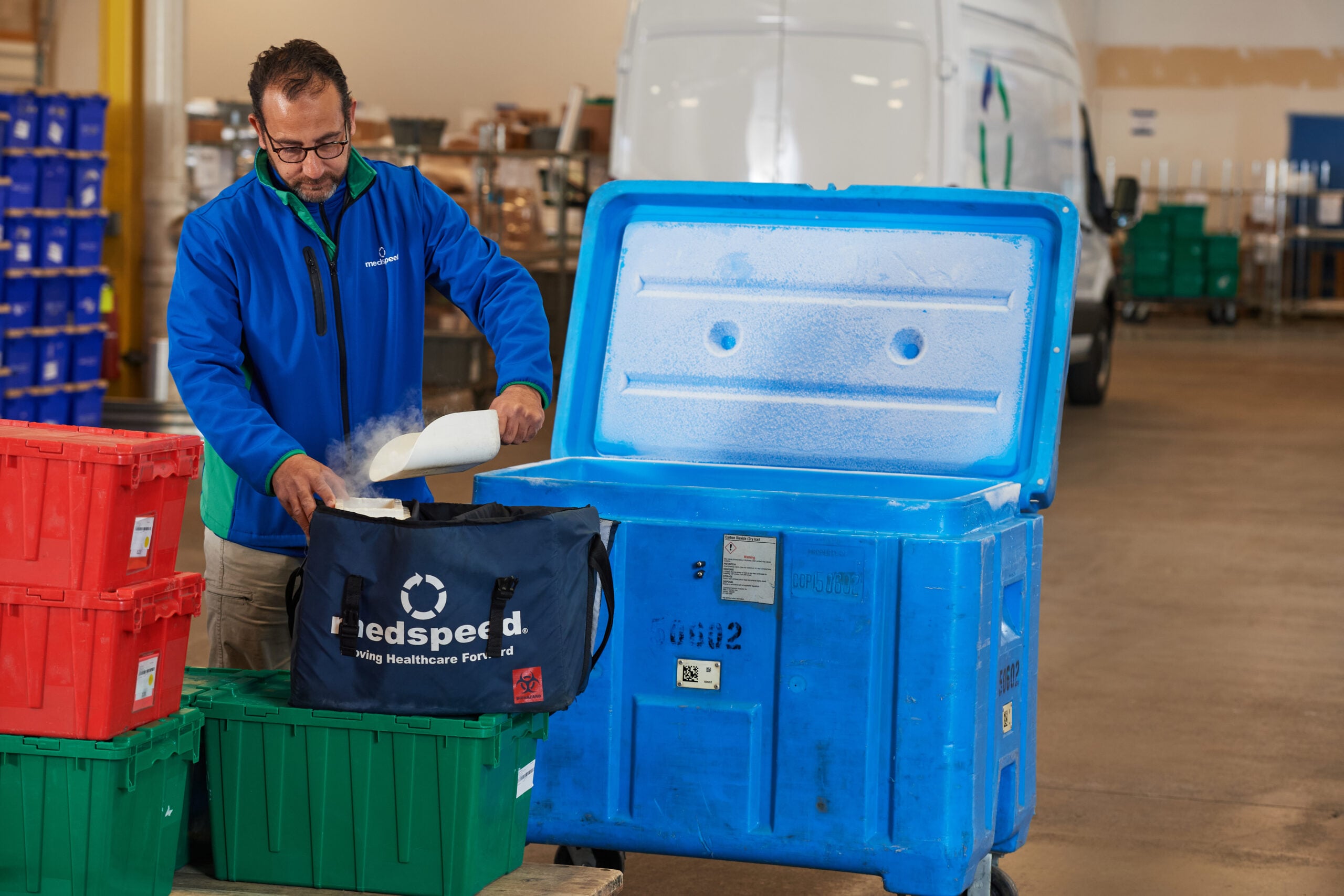
Every MedSpeed logistics service representative (LSR) completes our 20-day Blue Shirt Certification program, which prepares MedSpeeders for the unique demands of healthcare logistics. Training covers applicable regulatory requirements including HIPAA, OSHA, and DOT, as well as proper handling and packing procedures, chain-of-custody documentation,
MedSpeeders are also trained to recognize, report, and respond to potential quality and safety issues, including scanner alerts, delivery delays, biohazard spills, unexpected events, and other special handling situations.
Safety is an important part of that training. MedSpeed’s Make Every Day Safe program is designed to build a stronger culture of safety through ongoing training that helps employees identify hazards and respond effectively. Driver screening, pre- and post-route vehicle inspections, and our Driving Safety Scorecard provide additional safeguards. We also recognize MedSpeeders who consistently demonstrate safe driving behaviors.
A centralized learning management system (LMS) supports all of these efforts by standardizing training across the organization and tracking completion.
People need a process they can rely on
When you are moving millions of healthcare items across different facilities, departments, and markets, you cannot rely on everyone making the same decisions from scratch. People need to know what is expected, how materials should be handled, and what to do when something changes.
MedSpeed uses standardized operating procedures to establish clear expectations for handling, transporting, and delivering healthcare materials. These procedures guide our MedSpeeders through each step of the process, from pickup to delivery.
At the same time, standardization does not mean every customer operates the same way. MedSpeed supports hundreds of healthcare organizations, including 10 of the top 20 in the U.S., each with different workflows and requirements. We work closely with our customers to incorporate item-specific handling, safety, privacy, and documentation requirements into our operations.
These customer-specific processes are built on a foundation of standard procedures that align with applicable regulatory requirements and industry guidance. Depending on the materials being transported, this may include OSHA and DOT regulations for infectious substances, Association for the Advancement of Medical Instrumentation (AAMI) guidance for reusable medical instruments, USP 800 standards for handling hazardous drugs, DOT regulations for nuclear medicine, and federal and state regulations for controlled substances.
Our company-owned fleet, logistics hubs, and centralized operational support provide the infrastructure needed to put these processes into practice.
Technology gives our people the tools they need
Technology is another way we drive quality. We developed proprietary technology specifically for healthcare logistics because transporting specimens, medications, and other critical healthcare materials requires a different level of accuracy, accountability, and visibility than off-the-shelf technology can provide.
Our LSRs use handheld scanners that guide them through their daily responsibilities and support chain-of-custody documentation, pickup and delivery verification, exception identification, and ensure correct temperature handling.
Our technology gives our operations team and customers greater visibility throughout the delivery process. Barcode scans, and time-stamped pickup, delivery, and temperature-state records help our teams monitor service in real time to identify potential issues early and take immediate action, so patient care is not impacted.
How we respond matters just as much as how we prepare
Things will not always go according to plan. Severe weather, equipment failures, staffing challenges, and unexpected changes in demand can all affect service. We prepare our teams for the unexpected so they respond quickly and limit the impact on our customers.
If a service failure occurs, our first priority is to address the immediate impact. Our local operations teams and 24/7/365 control center work together to assess the situation, communicate with the appropriate customer contacts, and determine next steps. Depending on the situation, that may include arranging a STAT delivery, adjusting transportation plans, or using backup vehicles and resources from our connected network to maintain service.
Once the immediate issue is resolved, we need to understand why it happened and how to prevent it from happening again. Our quality team works with local operations and the customer to determine the root cause, which may include reviewing service documentation, employee training records, operational data, and customer feedback. Through our Corrective Action Report (CAR) process, we document findings, track corrective actions, and analyze trends to help prevent similar issues in the future.
We use what we learn to make changes, whether that means providing additional training at the local level, updating a procedure, or addressing an operational issue.
It all comes back to the patient
Healthcare organizations depend on reliable logistics to keep their operations running. They need to know that their critical materials will arrive when and where they are needed in the right condition.
MedSpeed brings together the right combination of people, process, and technology to drive superior quality in the industry, which means our healthcare customers can spend less time worrying about logistics and more time focused on their patients.